I remember the exact moment. Mile 6 of an easy Tuesday run, and my left kneecap felt like someone was driving a dull screwdriver into it. Every step downhill was agony. I spent the next three months doing what everyone does — rest, ice, compression, elevation. It didn’t help. The pain came back the second I hit 4 miles again.
Turns out, runner’s knee (patellofemoral pain syndrome) isn’t a knee problem. It’s a hip and quad problem. Your kneecap tracks wrong because the muscles above it aren’t pulling evenly. I learned this the hard way. After trying five different physios and spending $400 on a custom brace that did nothing, I finally fixed it with five targeted exercises. Here’s exactly what worked for me.
Why Most Runner’s Knee Advice Is Wrong
Everyone tells you to stretch your quads and foam roll your IT band. I did that for weeks. Zero improvement. The research backs this up — a 2019 review in the British Journal of Sports Medicine found that stretching alone has almost no effect on patellofemoral pain. The problem isn’t tightness. It’s weakness.
Your kneecap sits in a groove on your femur. Every time you bend your leg, your quadriceps pull on it through the patellar tendon. If your vastus medialis obliquus (VMO) — the teardrop muscle on the inside of your quad — is weaker than your vastus lateralis (outside quad), your kneecap gets yanked sideways. That grinding against the bone is what hurts.
Then there’s your glutes. Weak gluteus medius lets your thigh rotate inward when you land. That internal rotation torques your kneecap even more. Fix the glutes, fix the tracking. It’s that simple.
The mistake I see everyone make: they do knee exercises. Leg extensions, leg presses, even squats. These load the joint while it’s already misaligned. You’re literally grinding bone on cartilage. Stop doing that.
The Five Exercises That Fixed My Knee
I did these five exercises every other day for eight weeks. After week three, I could run 5k pain-free. After week six, I did a half marathon. Here’s the exact routine.
1. Straight Leg Raise (VMO Focus) — Lie on your back, one leg straight, the other bent. Tighten your quad on the straight leg. Lift it 12-18 inches off the ground. Hold for 3 seconds. Lower slowly. Do 3 sets of 15. The key: point your toes slightly outward to engage the VMO. If your foot flops inward, you’re using the wrong muscle.
2. Side-Lying Clam Shells — Lie on your side, knees bent at 45 degrees, feet together. Keep your pelvis stable and lift your top knee while keeping feet touching. Lower slowly. 3 sets of 20 each side. This directly targets gluteus medius. I use a thin resistance band from TheraBand ($12 for a roll) just above my knees. Without the band, this exercise is almost pointless.
3. Single-Leg Glute Bridge — Lie on your back, one foot flat on the floor, the other leg straight up. Push through your heel and lift your hips until your body forms a straight line from shoulders to knee. Hold 5 seconds. 3 sets of 10 each side. This activates the gluteus maximus, which takes load off your kneecap during running.
4. Step-Downs (Controlled) — Stand on a 6-inch step or sturdy box. Slowly lower one foot toward the floor, keeping your weight on the standing leg. Touch the floor lightly, then push back up. 3 sets of 12 each side. The descent should take 3-4 seconds. Most people rush this. Slow is the whole point — it forces your VMO to control the kneecap through the full range.
5. Wall Sits with Isometric Hold — Slide down a wall until your knees are at 90 degrees. Press your back into the wall and squeeze a yoga block or rolled-up towel between your knees. Hold 30-45 seconds. 3 sets. This builds endurance in the VMO without any dynamic loading. I set a timer on my phone — anything past 60 seconds and my form breaks down.
| Exercise | Sets | Reps/Hold | Key Cue |
|---|---|---|---|
| Straight Leg Raise | 3 | 15 reps | Toes slightly out, hold 3s at top |
| Clam Shells | 3 | 20 reps | Keep pelvis still, use band |
| Single-Leg Glute Bridge | 3 | 10 reps | Push through heel, hold 5s |
| Step-Downs | 3 | 12 reps | 3-4 second descent |
| Wall Sit | 3 | 30-45s | Knees at 90°, block between knees |
When NOT to Do These Exercises
This routine works for 80% of runner’s knee cases. But there are situations where you need to stop immediately and see a doctor.
If you have sharp, stabbing pain that makes you catch your breath, that’s not muscle weakness. That could be a meniscus tear or patellar tendonitis. These exercises will make it worse.
If your knee swells visibly after running or after these exercises, stop. Swelling means inflammation, and inflammation means something is damaged, not just weak. Ice it for 15 minutes and take 3-4 days off completely. If swelling returns when you restart, see an orthopedist.
If you feel instability — like your knee is going to give out — that’s a ligament issue. ACL, MCL, or PCL problems need different treatment. Don’t mess with these. Get an MRI.
I made the mistake of pushing through sharp pain for two weeks. I ended up with a patellar stress reaction that took four months to heal. If an exercise hurts during the movement (not after), stop. Find a different exercise that targets the same muscle without the pain.
The Equipment You Actually Need
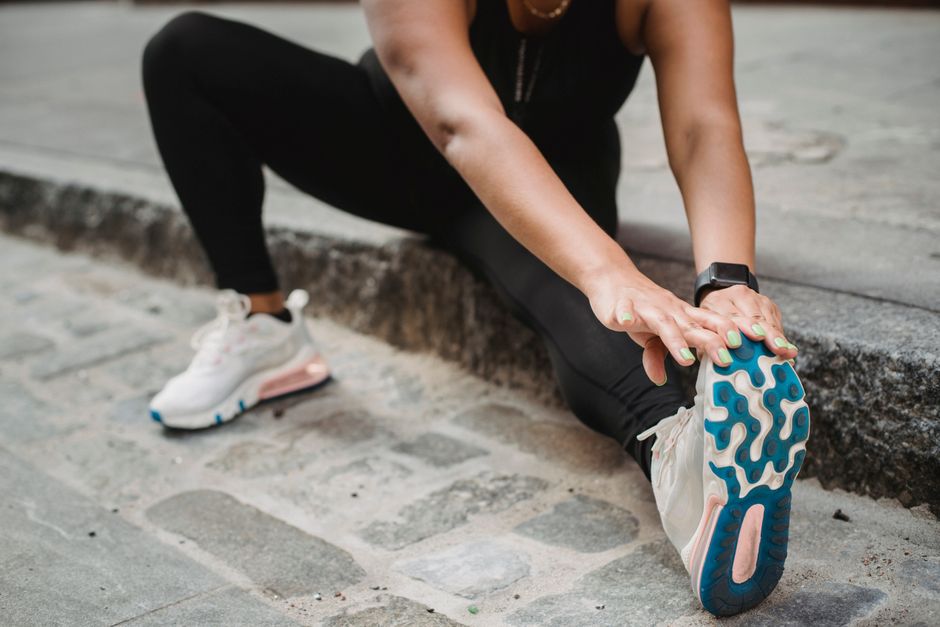
You don’t need a gym membership. I do all five exercises in my living room. Here’s what I actually use:
- TheraBand Resistance Bands ($12, pack of 3 resistance levels) — The red one is perfect for clam shells. Don’t buy the cheap drugstore bands that snap after two uses.
- Yoga block ($8 on Amazon, any brand) — For the wall sits. A rolled towel works too, but a block gives consistent thickness.
- 6-inch step or sturdy box — I use a $15 aerobic step from Gaiam. A stair works fine, but make sure it’s not carpeted — you need stable footing.
- Running shoes with 8-12mm drop — I switched from zero-drop Altras to Brooks Ghost 15 ($140) during rehab. The higher heel-to-toe drop reduces strain on the patellar tendon. Controversial take, I know. But it worked for me during the recovery phase. I went back to lower-drop shoes after six months.
What I don’t use: Knee sleeves, patellar straps, or braces. I tried a $60 Shock Doctor brace. It felt supportive but made my quad weaker because it did the work for my muscles. If you can’t activate your VMO without a brace, you’ll never fix the underlying weakness.
How to Return to Running Without Re-injury
I came back too fast the first time. Big mistake. Here’s the protocol that finally worked.
Week 1-2: Do the five exercises every other day. No running. If you feel pain during the exercises, scale back the reps by 50%. You should feel muscle fatigue, not joint pain.
Week 3: Add walking. 20 minutes at a brisk pace. If pain-free after three walks, try 1 minute jogging intervals. Walk 4 minutes, jog 1 minute. Repeat 4 times. I used the Couch to 5k app format but compressed the timeline.
Week 4: Increase jog intervals to 2 minutes, walk 3 minutes. Total time 25 minutes. Still do the exercises on your rest days, not your run days. Your muscles need recovery after running.
Week 5-6: Jog 5 minutes, walk 2 minutes, repeat 3 times. By week 6, I was running 20 minutes straight at a conversational pace (around 10:00/mile for me).
Week 7-8: Normal easy runs, but never increase mileage by more than 10% per week. I jumped from 15 miles to 22 miles in week 7 and felt a twinge. Backed off to 18. Patience is everything.
The single most important rule: stop at the first sign of kneecap pain. Not after you finish the run. Immediately. Walk home. Take two days off. If you push through, you reset the clock by weeks.
What I Wish Someone Had Told Me
Runner’s knee isn’t a training error. It’s a muscle imbalance that builds up over months or years. You can’t fix it in a week. I wasted three months on rest and stretching when what I needed was targeted strengthening.
If you want the short version: strengthen your VMO and gluteus medius, stop doing exercises that load the kneecap directly, and never push through sharp pain. The five exercises above are the exact routine I used. No fancy equipment, no gym membership, no magic brace.
For most runners, the TheraBand resistance band pack ($12) and a yoga block ($8) is all you need. Do the routine every other day for eight weeks. If you’re not pain-free at 5 miles by week 8, see a sports physio who specializes in patellofemoral pain — not a general practitioner who tells you to stop running.
Medical Disclaimer: This content is for informational purposes only and does not constitute medical advice. Always consult a qualified healthcare professional before making health-related decisions.