Proprioception, sometimes called the “sixth sense,” is your ability to sense where your body is and how it is moving without watching every movement. It helps you place a foot on a step, adjust your stance while reaching, and coordinate your arms and legs during exercise. Practicing controlled movements can help you become more aware of these adjustments and build balance skills.
Proprioception exercises can fit into an ordinary fitness routine. You do not need a balance board or complicated equipment: a clear floor and a sturdy countertop are enough to begin. The aim is a manageable challenge that lets you practice good control. If you have recurring falls, dizziness, numbness, or an injury that affects walking, ask a clinician or physical therapist for guidance before progressing.
Key Takeaways
- Proprioception works with vision and the inner ear to support balance and coordination.
- Start with supported movements on a firm surface, then gradually increase the challenge.
- Short, consistent practice gives you opportunities to improve control without rushing.
Understanding Proprioception And Its Role In Balance And Coordination
Balance is the ability to keep your body steady, whether you are standing still or moving. Coordination is the timing and organization of movements, such as stepping forward while reaching with the opposite arm. Proprioception supplies information that helps both skills. A useful exercise asks you to notice your position, make small corrections, and repeat a movement with control.
The Science Of Proprioception
Sensory receptors in muscles, tendons, and joints send information to your nervous system about position, stretch, and movement. Your brain uses that information to adjust muscle activity. You can notice this awareness by sitting down, closing your eyes, and slowly bending one elbow: you still have a sense of your arm’s position. Standing balance exercises challenge this feedback alongside other systems involved in stability.
The Importance Of Balance And Coordination
Your eyes provide information about the surroundings, while the vestibular system in the inner ear detects head movement and orientation. Your nervous system combines these signals with body-position feedback. This is why dim lighting or turning your head can make balancing harder. For beginners, keeping the eyes open and looking at a stationary point makes practice more manageable.
Effects Of Aging On Proprioception And Balance
Body-position sensing, muscle strength, vision, and reaction speed can change with age. Balance difficulties may also reflect medication effects or health conditions, so they should not automatically be dismissed as aging. Supported exercise can be part of maintaining movement skills, but new or worsening unsteadiness deserves assessment. Older adults who feel unsure can begin with both feet grounded and a hand on a stable surface.
Proprioception Exercises For Enhanced Stability And Performance
Before starting, clear away loose rugs and obstacles. Wear secure footwear and use a firm, nonslip floor beside a countertop or sturdy rail. Avoid relying on a rolling chair. Warm up with a few minutes of comfortable walking or gentle marching. During each drill, breathe normally and stop before fatigue makes your movements sloppy. The following amounts are starting points, not targets you must force yourself to reach.
Balance Exercises
Weight shifts: Stand with your feet about hip-width apart and fingertips on the counter. Slowly move your weight toward one foot without lifting either foot, then return to center and shift the other way. Keep your trunk tall rather than leaning from the waist. Try five shifts in each direction. This is a useful first step if lifting a foot feels too difficult.
Single-leg stance: Holding the counter, transfer your weight onto one leg and lift the other foot just above the floor. Keep the standing knee soft and your pelvis approximately level. Hold for five to ten seconds, lower slowly, and switch sides. Repeat two or three times per side. Make it easier by leaving the lifted foot’s toes on the floor; progress by gradually reducing hand pressure while keeping support within reach.
Heel-to-toe stance: Place one foot in front of the other, with the front heel near the back toes. Hold for ten to twenty seconds, then swap feet. If this is too narrow, leave a small sideways gap between your feet. When you can stand comfortably, try several slow heel-to-toe steps along the counter. Pause between steps instead of hurrying to regain balance.
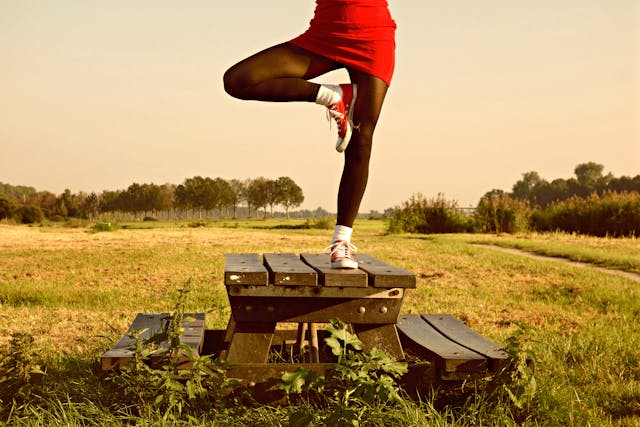
Tree pose offers another way to practice single-leg control: place the raised foot against the standing ankle or calf, avoiding pressure directly against the knee. Keep a hand on support. Balance boards are optional and introduce extra difficulty; learn the floor-based versions first and seek supervision if you are uncertain.
Strength Training And Flexibility
Controlled chair squats: Stand in front of a sturdy chair secured against a wall. Move your hips back, bend your knees, and lower toward the seat. Sit lightly or hover only if comfortable, then stand steadily. Keep your knees tracking in the same direction as your toes. Begin with five to eight repetitions, using your hands for assistance when needed. Notice whether you place similar pressure through both feet.
Bird dog: Start on hands and knees on a comfortable mat, with hands under shoulders and knees under hips. Slide one leg backward while keeping your trunk steady. If that feels controlled, lift the leg slightly and reach the opposite arm forward. Hold briefly, return slowly, and alternate for four to six repetitions per side. Start with only an arm or leg movement if your back arches or your hips rotate.
Comfortable ankle and hip mobility helps you move through these drills. Gentle ankle circles and slow heel raises with hand support are simple additions. Tai Chi also combines controlled weight shifts with coordinated movement. Stretch within a comfortable range, avoiding bouncing or forcing a joint into position.
Dynamic Movements For Coordination
Clock taps: Stand beside support and imagine a clock on the floor. Keep most of your weight on one leg while tapping the other foot forward, sideways, and backward. Return to the starting position between taps. Complete three rounds on each side. Keep taps close enough that you can stay upright without twisting or grabbing the counter.
Slow marching: Lift one knee to a comfortable height, pause briefly, and lower the foot quietly before switching. Practice for twenty to thirty seconds near support. Once steady, add a gentle opposite-arm swing. Focus on deliberate foot placement and smooth timing rather than knee height or speed.
Hopping, skipping, and direction-change drills are later options for people who already tolerate impact and have reliable balance. Begin with controlled stepping patterns first. After an ankle sprain, surgery, or another injury, a physical therapist can help decide when faster or sport-specific movements are appropriate.
Putting The Exercises Into A Routine
Start with five to ten minutes on three days each week. Choose weight shifts, one balance hold, chair squats, and either clock taps or marching. Rest between exercises as needed. Progress one feature at a time, such as a slightly longer hold or lighter hand contact. Keep your eyes open; closing them is unnecessary for a useful home routine.
Track practical changes, such as completing the same hold with less hand pressure or placing your feet more smoothly. Small wobbles are expected, but repeated grabbing, pain, or dizziness means you should stop and reassess. Consistent, controlled practice is the foundation: select exercises you can perform safely and build from there.